Why
Most “AI for markets” products hide the model’s track record. CopeNet keeps a forward ledger: every call is written down before the outcome exists, then scored against what the market did. If the analyst is wrong, the page says so. It runs on your machine, on free data, and places no orders. There is no code path that could.
What’s inside
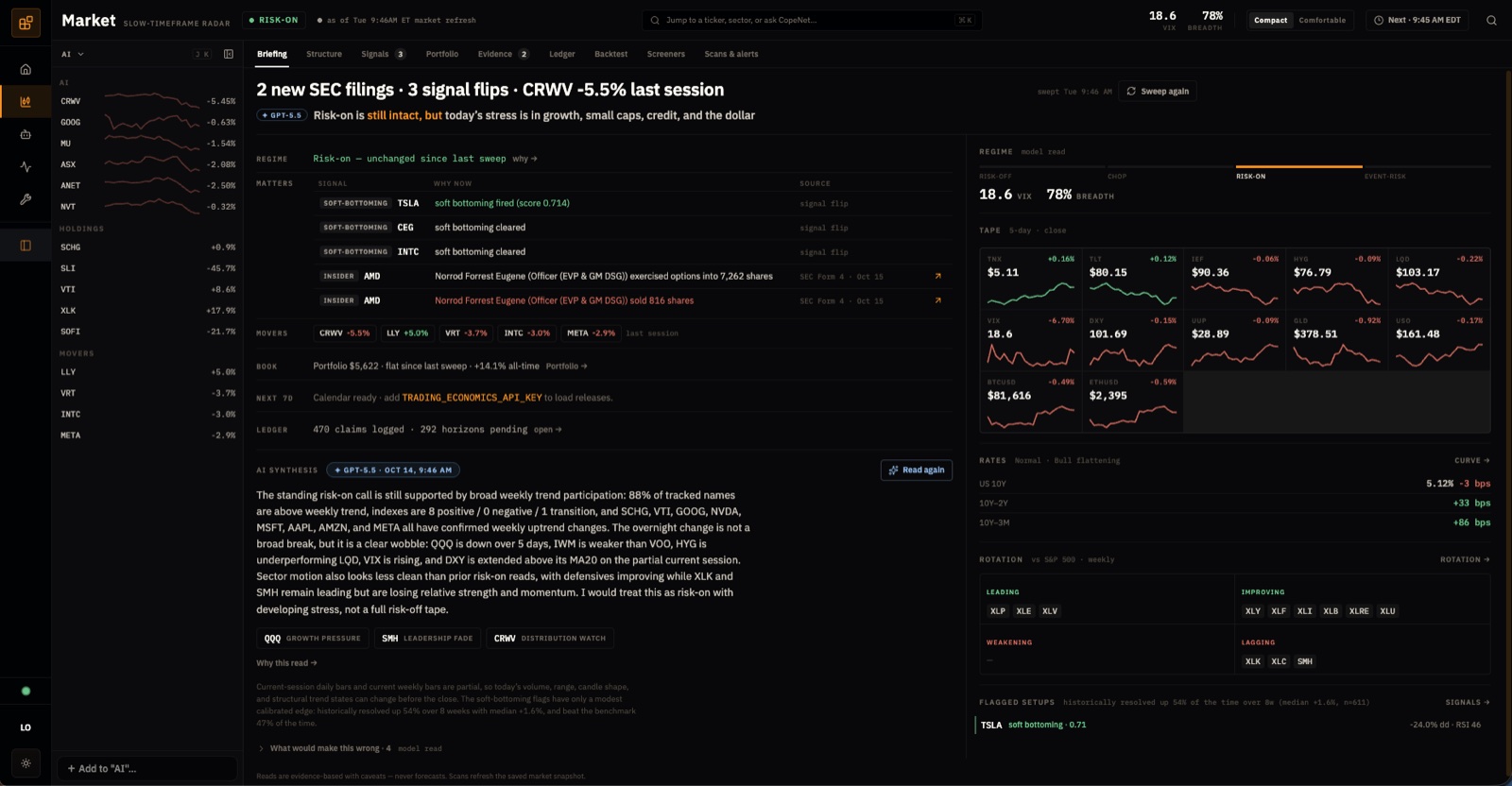
- A market workstation with a weekday morning brief: watchlists, SEC filings and insider activity, sector rotation and macro, each call paired with what would prove it wrong.
- A ticker workspace with split-adjusted history, intraday bars from 1m to 4h, indicators, drawing tools, bar replay and formula symbols like
VOO/GLD. - Free data only: Yahoo Finance, SEC EDGAR through CopeTech-Edgar, the TradingView screener, US Treasury, FRED and Trading Economics.
- A chart agent that receives a frozen snapshot of exactly what is on screen.
- The forward ledger. Chart forecasts are frozen, plotted and tracked against price.
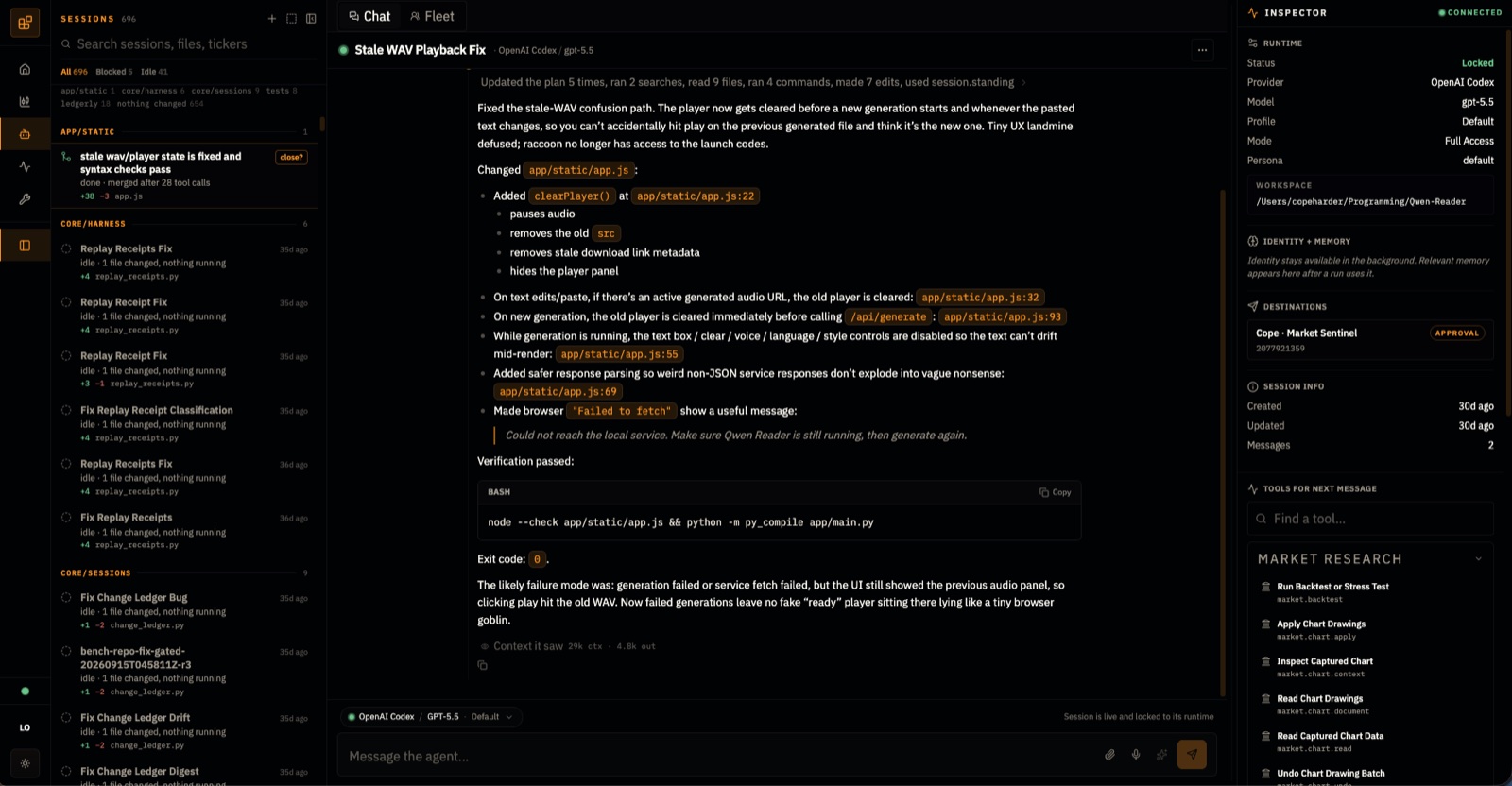
- An agent console for Claude Code and Codex with three access modes, read-only, ask and full, and a receipt for every tool call.
- Phone access over Tailscale and alerts over Telegram.
The harness
The harness runs persistent sessions where a model calls real tools: files, shell, web, market data, memory. Access is policy, not vibes. Each session runs read-only, ask or full, and risky commands wait for approval. Every tool call is recorded in order with its arguments, output and the policy decision, so a run can be reconstructed from durable records rather than from whatever the UI remembered. A change ledger tracks edits across turns and tells the agent when a file changed on disk underneath it.
Fleet rooms give two models the same question. Each answers on its own, then they critique each other. Prompts are plain Markdown: profiles, access overlays, personas.
Status
Active. Started local-only in March 2026 and moved to frontier models in September. It is one finished app, not a framework. The design grammar for this site came from its market workstation.